

Books and Writing
Books and Writing
Letter 4: You don’t win a long shot without making a bet
- Details
- Published: 28 April 2013 28 April 2013
I’m not exactly sure what emboldened me to become an actor. Or at least make an attempt at it. Maybe it was that gambler’s streak on my father’s side of the family. As I said, my Uncle Frank, who was actually my father’s uncle, was a bookie for many years and a professional card player. Several of Uncle Frank’s brother’s were gamblers as well. Over the years we got to hear some of those stories such as Uncle Pete’s Ha, Ha club in NYC, during the 50’s, where Burt Lancaster came and many bets were placed on ball games, or Uncle Bennie who owned Top of the Mast down the Jersey shore, or Uncle Jimmy, who was always borrowing money from Uncle Frank to cover his losses. These were my father’s uncles. His Dad, also named John, was a straight laced businessman who would have nothing to do with gambling.
My gamble was a different kind of gamble. I believed I was investing in myself and thus when I determined to become an actor, I wanted to be prepared as much as possible, taking an acting class at Michigan and getting in my first play, going to summer school at the Academy of Dramatic Arts, doing an internship at the American Stage Company in Teaneck, NJ, where I was also studying scene study, and finally getting a summer internship in summer stock theatre. By any measure, these were just the starting points for pursuing a career in acting. But when you are young, you expect that the world will open its doors to you and that you will step through into the room of success, immediately. Like most actors, I was waiting for that big break, expecting that it could come at anytime.
It was during that summer at the Hampton Playhouse in Hampton, New Hampshire, that I received another batch of Dad’s letters. About one a week over an 8 week period. That season he was occupied with horseracing, as he had never been before, because a couple of his doctor friends persuaded him to become a part owner in a horse that would turn-out to do phenomenally well on the horse trotting circuit. They were winning races and thus taking home the winning purses. And they were spending a pretty penny to keep up an extravagant horse racing lifestyle.
In one of those letters Dad touched on it:
Few horses ever win let alone get to the great races. It’s been a thrill due to pure luck. He has won over $200,000. We paid $77,000. We have been paid back $70,000 and if he wins another race or two we should make a few dollars. Vet bills, training and entrance fees ate up the rest. Few in horse racing make a lot of money and as soon as we make a profit Uncle Sam will get 38%. But has it been fun! Most horse owners are rich to begin with but few can buy their way into the “Hambo.” (Dad was referring to the Hambletonian, the Kentucky Derby of the Trotta Racing World).
When we were growing up, Dad enjoyed the horse races on a much smaller scale, taking our family to Belmont where we’d sit in one of the par chairs and enjoy an afternoon watching horses run, placing small bets and having a nice lunch. To me, it seemed very civilized. Because Dad was a doctor, he had some special privileges and entitlements, which I always admired, realizing not only is there a price to be paid for becoming a doctor, but that there are “perks” as well. Once I became a successful actor, I too would be afforded similar opportunities, I thought to myself. The sky was the limit when you made it as an actor.
I really enjoyed those trips to the horse races, as the idea of placing a two dollar bet on a horse and winning really appealed to my sense of adventure. It also exercised my mind as I would pour over the horse racing notes, studying each horse’s profile before I placed my bet. There was more to betting than just throwing your dime down like you might on a lottery ticket. Horse racing was a game of strategy. My Uncle Frank was a poker player and that too was a game of strategy in which he fared well because he knew the game better than most. Gambler’s could be winners if they knew what they were doing. Aspiring actor’s could make it to the top of their game if they properly calculated a path to success. Smart strategy was the name of the game and my strategy was to get experience and pay my dues on my way to the top.
My summer at Hampton was an internship, mostly in which I had opportunities to act in some children’s theatre like the Adventures of Tom Sawyer, playing the role of Judge Thatcher, or doing some background work in one of the main stage musicals, like 42nd Street and My One and Only, where I had a bit part as a photographer. I was not a musical theatre guy, not having training or confidence in singing and dancing, and so most of the roles in the theatre productions did not avail themselves to me. Like most interns, I worked on props management, set building, working the spotlight during show time and parking cars prior to the curtain’s opening. Hampton Playhouse was about a mile or so down the road from the beach, where I would routinely go to workout, jog and bring my journal and write. Frequent parties amongst the cast and interns also made summer stock a most enjoyable and memorable experience. I even met a girl who lived there for the summer and we had a romance for a couple of weeks.
Another letter from my father came around this time, expressing concern about my future.
Dear George.
It was good to get your letter and I’m glad the summer has turned out well for you. I’m concerned about your future. I won’t discourage you. I believe you are obligated to determine your own fate, just as you should be the one to reap its rewards or take the honest blame should it fail….Unfortunately, the career you have chosen is not only uncertain, it is painfully associated with chronic financial discomfort. But such is the lot of every true artist. Most of the time there is great alienation from family as few parents bestow their blessings toward such an uncertain endeavor. You have my blessing but I worry.
I’m sure you agonize daily, weigh all the minutiae over your progress, ability and commitment. I have no advice to give and no one has more faith in you than me. I want you to be happy but certainly cannot be a cause of it for very long.
Somehow, like all of us, you are as much a product of your times as your genetic make-up. Some unknown force propels you to the most difficult of tasks. I guess you will be up for it when the time comes, but like the rest of us you too may not be another “Amadeus.” George, when you are close to being broke (I’ve been there like most), you begin to panic or think less clearly. You deserve a chance to get to your goal. Enclosed is a check which should take some of the pressure off. It’s not a legacy; it’s what I can afford.
With every letter that Dad sent that summer, there was a check in the envelope to help me get through that summer. Dad’s checks always took the financial burden off. But I wonder if it would have made me hungrier for earning my own success if those checks never arrived and I had to earn it on my own?
Biloxi Blues was the last play of the season and it was my great hope that I would be cast in it. After seeing it on Broadway starring Mathew Broderick I decided at that point I was going to become an actor. To get cast in the play, one of the few straight plays in Hampton’s repertoire, would mean a lot to me. Unfortunately after trying out, I was not cast and recall being very discouraged, as I had not made the cut while a couple of my intern buddies made it into the show. I took it personally, as if the executive directors at the Playhouse simply overlooked my talent.
I must have expressed to my father my desire to continue studying acting after this setback. My father responded, who was now exuberant over Crown’s Best, who had just won a big race in Saratoga, breaking a track record and was headed to the Hambletonian.
He wrote:
Only a handful of horses have ever run this fast, making him much more valuable and a possibility to be selected for a stud at the end of this year. We seem to have a horse! It is exciting to win a long shot, and George you are part of a similar horse race. It is a gamble whether you will come out on top and the process of becoming is long and the stakes in both cases very high and higher in your case because it becomes an all or nothing, your whole career at stake. You don’t win a long shot without making a bet.
We learned some things with the horse. He needed a good trainer. Who trains you? You seem to be getting exposure, then you mention “connections.” I guess you need to make them, but how? Graduate School? Dad is down on schools but Dad has been wrong too often. Just seems like such a waste for “connections.”
At this point I was intent on studying acting further, desiring a secure place where I could safely pursue acting without the fear of failing. More time, either in graduate school, or acting school might be that secure haven and so I was committed on embarking on a more formal education to get me to my goal. That strategy seemed to work for my father, when he embarked on a road to medical school. That same road could work for me too. I would get training and become skilled as an actor.
Looking back, my father seemed to be right. Should I have listened? But then again, I was responsible for my own destiny. In one of the letters that summer my father included a newspaper clipping about one of my best friends in elementary school, whose marriage to his high school sweetheart was announced in the local paper, with a mention of their distinguished honors in college, graduates of such and such school, with bright prospects for their future together, as they would reside in NYC and were certainly headed toward having children and living the American Dream.
I would take another road. It became painful, as the years passed, and I did not taste victory from the cup of my own pursuits, that I had possibly missed out on a rite of passage that belonged to my friends, who chose steadier and more certain paths. That I did not lean on my honors or credentials and seek the more conventional path of career and children would be a source of ambivalence and later self-doubt, as my plans did not go as expected.
Had I really chosen my destiny or would I have to wait longer to find out? I would guess your destiny is never really known until the fat lady sings and the show is over.
Crown’s Best never did win the Hambletonian. He was beaten by Mack Lobell, who turned out to be a superb horse. In the Chicago Tribune it was written:
The most dominant athlete in sport is not Orel Hershiser or Jose Canseco. Not Mike Tyson or Michael Jordan. Not even Steffi Graf. No, the closest thing we have to a mortal lock these days is named Mack Lobell, and when he is really cranked up, all four legs are off the ground simultaneously and there is this distinct impression that he really is running on air. He holds track records at nine tracks. No trotter in history has ever raced a mile faster than he-over a half-mile track, a...
There was disappointment of course. But there were never any illusions that Crown’s Best would prevail. “It was pure luck,” Dad said, “that he had come this far.”
Soon after Crown’s Best, my father bought another horse named 'Morning Glory.' There was one letter that made mention of him. But I never heard anything further, assuming the horse did not make the grade and was soon sold off.
You don’t win a long shot without making a bet. I suppose learning when to fold em’ is another lesson to heed. I was still running with no signs of slowing down. I didn't even know what the field ahead looked like. I was a very stubborn horse, wearing blinders.
Letter 3: Live a Life of Relevance
- Details
- Published: 11 April 2013 11 April 2013
September 1987
As I was pursuing my new acting ambitions after I graduated from Michigan, I could not help but desire a taste of greatness. I surely had much to prove to the world and myself, as any graduate might with bright hopes for their future. The idea of being a great actor, when I chose acting, superceded the idea of being a “good actor” or a “good anything” for that fact. Who wants to be good when they can be great?
My father had instilled that desire for greatness, not by beating it into my head, but by imbuing it through rewarding good actions. A winning touchdown pass that I threw as an 8th grade football player in the last moments of a football game was a defining moment that said to me such feelings were worth pursuing. How wonderful were the rewards that came from winning and/or receiving that special something from Dad, even if it was just a pat on the back and encouraging words like “Great job.”
After that ecstatic junior high school football victory, my father rewarded me with a twenty dollar bill and treated me and my friends to pizza. Extrinsic rewards worked well for me as I found that pleasing my father always worked to my benefit like following the law pleases our justice system.
When I received a trophy for Most Valuable Player on the high school football team several years later in 1981, I realized the road was few and far between those fleeting moments of great, heroic acts like throwing winning touchdown passes in the last seconds of a game. Unfortunately, there weren’t too many moments like that day. Dad reminded me that the rewards of glory are few and far between and not to count on them for the fulfillment of one’s destiny, pointing to a few former high school star athletes from his hometown who graduated and were still hanging out on a park bench reminiscing about their glory days.
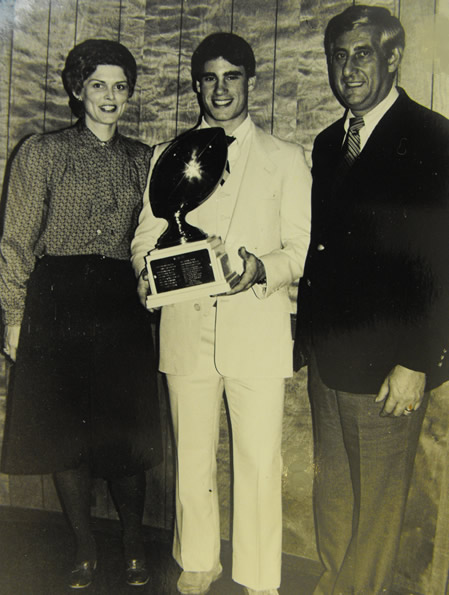
My glory was a different kind of glory, but more sustaining. I learned it was through steady discipline, consistent action and riding the ups and downs of the rocky road ahead, for better or worse, over a long period of time, that was the way to greatness, if it were to be achieved at all. Sticking to it, like my father had done to become a doctor, was the way to a more successful future. Over the years Dad would point to that trophy, encouraging me that I could do anything if I set my mind to it.
This “greatness” thing was hanging over me like a huge cloud that defined my being. That I had to be something was culturally rooted in such films like On the Waterfront with Marlon Brando’s character telling his brother about his desire to be a contender or Rocky Balboa waking up one day to realize he’s not lived up to his potential; in sports with role models like Michael Jordan winning championship games for the Chicago Bulls and John Elway winning two Super Bowls in the twilight of his career; or maybe it came from just being an American where we are instilled with the idea that we are the greatest nation on earth. Wherever this idea of greatness took root, from great civilizations of World History to our great forefathers of America or in the great characters of the plays of William Shakespeare, the bug bit me hard and I wanted something more out of my life than mediocrity.
My father must have picked up on my anxiety when I told him about this desire for greatness.
Dear George,
To say “I want to be great” (at what I do with my life) is an admiral character trait. Great for what? Glory? What will be the relevance of such greatness? How can one’s life be relevant? Relevance is the oft forgotten attribute missing in many so-called greats, in the tragic heroes and their flaws.
Greatness is too broad a term. All Ruth’s homeruns, the many movies of a Woody Allen. So many famous people, so many accolades. Yet, each must ask despite his so called greatness, what is it that makes my life relevant.
Each of us has a capacity for relevance because relevance relates usually to the society, friends and family around us.
So after one becomes great, it is also important that such a life is indeed relevant. And should it fail to be relevant, such a life will be like a very beautiful but empty cup. It is great for its beauty, and empty of relevance. So if you do not have enough to strive for, I have reminded you of this other burden of relevance. This, however, is an easier more natural one because it is an easy habit to get into and measure everyday.
If a thing is irrelevant to you, then it must be avoided. Everyone’s life can be relevant and therefore great.
My father, as much as he talked about “greatness,” through his heroes like Winston Churchill and other political leaders, contemporary and historical, reiterated the necessity of relevance over the course of my life. When I got my first teaching position as a social studies teacher at a high school in Newark, NJ from 1990 to 1992, I realized that the way to my students’ hearts and minds was in making subject matter relevant. Textbooks that were dry coupled with tasks that were boring had very little relevance to the lives of black Americans, forcing me to find other ways to reach them. Spending extra hours at the library to learn African-American history and their key role models throughout history would bring greater esteem upon me than almost anything I had done in my life, including winning a football trophy.
I would become a much better teacher when I worked on the attribute of becoming relevant rather than focusing on greatness.
At the end of my father’s letter he advised me to keep writing and to keep a diary, which he had first encouraged when I went to Japan. It was an affirmation that he asserted throughout my life and he really did help me become a better writer, first through the confidence I gained in letters I wrote him and the several daily journals I kept for myself over several years and then later when I became a graduate student of writing, an English teacher and practicing writer myself.
I would not make the connection until much later in life about the influence of those letters - that through them, I was preparing myself for something I could not foresee. Where it was all leading, I would not know. But writing was my way of discovering my place in the world and my father gave me this confidence. Later, my knowledge of writing, both through the daily habit of doing it and the formal education I would receive would become the basis for more relevant acts in and out of the classroom.
Our lives are governed much more by positive influences than we may realize. It takes time to discover the thread of our existence and the reason why we are here on this planet and how it is shaped by very special role models such as people like my father or teachers in our schools and the great people who serve, in all walks of life, to inspire us through their presence.
The lesson of living a life of relevance would continue to play out over the next 25 years of my life until my father’s death. Nor would that lesson diminish with his passing but rather grow stronger like an orchestra band beating a steady drum to the Stars and Stripes Forever.